Hale-Bopp Comet
A comet is an icy, small Solar System body that warms and begins to release gases when passing close to the Sun, a process called outgassing. This produces an extended, gravitationally unbound atmosphere or coma surrounding the nucleus, and sometimes a tail of gas and dust gas blown out from the coma. These phenomena are due to the effects of solar radiation and the out streaming solar wind plasma acting upon the nucleus of the comet. Comet nuclei range from a few hundred meters to tens of kilometers across and are composed of loose collections of ice, dust, and small rocky particles. The coma may be up to 15 times Earth's diameter, while the tail may stretch beyond one astronomical unit. If sufficiently close and bright, a comet may be seen from Earth without the aid of a telescope and can subtend an arc of up to 30° (60 Moons) across the sky. Comets have been observed and recorded since ancient times by many cultures and religions.


Comet Hale–Bopp is a long-period comet that was one of the most widely observed of the 20th century and one of the brightest seen for many decades.
Alan Hale and Thomas Bopp discovered Comet Hale–Bopp separately on July 23, 1995, before it became visible to the naked eye. It is difficult to predict the maximum brightness of new comets with any degree of certainty, but Hale–Bopp exceeded most predictions when it passed perihelion on April 1, 1997, reaching about magnitude −1.8. Its massive nucleus size made it visible to the naked eye for a record 18 months. This is twice as long as the Great Comet of 1811, the previous record holder. Accordingly, Hale–Bopp was dubbed the Great Comet of 1997.
During the late spring months of 1997, I became aware of the event occurring in our heavens. Anxious to share the experience with my children; I gathered most (if not all) into my vehicle and embarked on our night time excursion to observe this uncommon astronomical visitor for ourselves. Inasmuch as I lived in the extremely well-lit heavens of Ontario, California; I determined that we’d have to drive to a locale that was devoid of manmade lighting such that we could observe this phenomenon for ourselves. I’d heard that the comet could be observed with the naked eye; and thus, we ventured into the less well traveled regions of Southern California in order to ascertain a locale that permitted unfettered observation within the darkened skies of the night. Upon arriving along the winding highway 79 (Ortega Highway) in the high mountains southwest of Lake Elsinore. As we drove in the darkened night hours; I worried that the excursion would be fruitless because I knew not what to look for and visibility of the heavens remained somewhat obscured by the lights visible from passing housing and intermittent retail signs. However, as we ventured further from the now distant hue of Elsinore communities; we found ourselves in the region of Ortega Falls and able to observe the brightness of the stars as we traveled the highway amidst its enveloping darkness. Not knowing what exactly to look for; the children stared at the heavens through their windows uncertain of what they were looking for. Finally, determining that we’d not be able to get much darker amidst the hued heavens of Southern California; I pulled off the highway onto an obscure dirt road in order to maximize our opportunities and be uninterrupted by passerby highway vehicles.
There in the stillness of our surroundings and staring at an emblazoned night sky; we were able to observe readily the brightened tail of the comet streaking through our sky. The cloudlike stream of particles trailing the comet’s bright ‘head’ could be seen by all my children and I was relieved that our excursion had not been in vain. Nevertheless, due to their young lack of full understanding; their enthusiasm quickly waned as the distance of the comet rendered its observation dramatically less animated as the television animations they become used to.
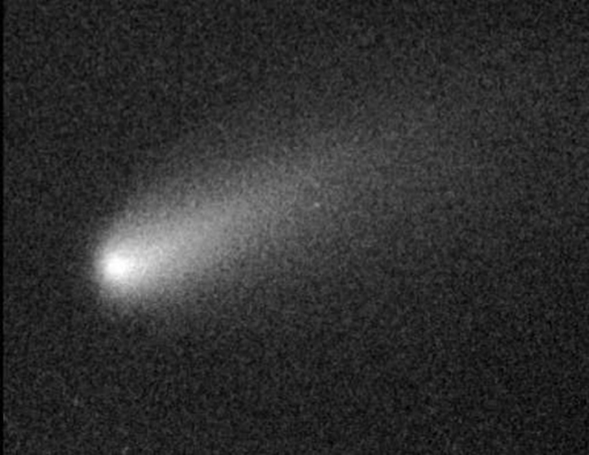
Having brought binoculars; each observed the comet as merely brighter and easier to discern as they observed the comet’s seemingly static presence. I endeavored to explain that which they were observing had come from outside our solar system and that it was traveling extremely fast. Unfortunately, I found myself unable to impress the magnitude of the observation on their young minds. The stoic gaze of their sleepy faces impressed upon me that the full extent of their ability to comprehend an unusual heavenly event would not be possible nor earth shatteringly significant.
With that our excursion into the darkened hills of southern California came to a tedious close as we piled back into the car and a boring drive back to my home. The event had been rather uninteresting to young minds and lackluster – despite a father’s fervent advocacy.
Create Your Own Website With Webador